

0 items £0.00
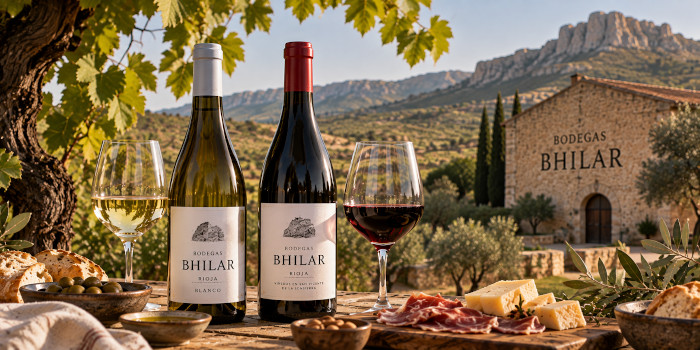
Bodegas Bhilar represents a particularly personal approach to Rioja. Based in the village of Elvillar in Rioja Alavesa, it is a small producer built around David Sampedro and Melanie Hickman's belief that careful farming and minimal intervention can allow individual vineyards, grapes and places to express themselves more clearly.
That philosophy matters because it influences the wines they choose to make. Bhilar isn't simply trying to reproduce a familiar Rioja style on a smaller scale. Particular vineyards, less obvious grape choices and individual winemaking ideas can all become reasons for making a wine.
That's what attracted us to Bhilar. The small-team, small-vineyard approach feels genuine, while the wines give us the opportunity to explore some less familiar expressions of Rioja.
Bhilar is a boutique winery in Elvillar run by husband-and-wife team David Sampedro and Melanie Hickman. David is a local winegrower, agricultural engineer and winemaker who began his own project in 1999 with just three hectares of vines.
From the beginning, farming has been fundamental to the project. David moved first towards organic viticulture and subsequently embraced biodynamic farming, while the vineyards are worked without conventional chemical intervention. Tractors were removed from the estate in 2014 in favour of working the soil with horses, and the vineyards later achieved Demeter biodynamic certification.
The same philosophy continues in the winery. Bhilar describes its winemaking as minimal intervention: rather than imposing a predetermined style upon the fruit, the aim is to give the character of individual grapes and vineyards room to emerge.
Bhilar's wines don't need to taste alike to belong together.
The common thread is an approach rather than a standard flavour profile: work closely with the vineyard, intervene as little as reasonably possible, and allow the character of the raw material to determine the direction of the wine.
That can mean concentrating on a particular vineyard. It can mean exploring a grape variety somewhere it isn't usually expected to take centre stage. It can also mean choosing a winemaking method because it suits the fruit rather than because it conforms to a familiar Rioja formula.
The result is a producer whose wines can feel exploratory without being different merely for the sake of being different.
If small-scale, vineyard-led and minimally interventionist winemaking appeals to you, Bhilar is certainly worth exploring.
It can be particularly interesting if you already know Rioja reasonably well and would like to see some of the less familiar directions the region can take. Equally, you don't need any previous Rioja knowledge to appreciate wines made with a strong sense of individuality.
You don't need to decide here which Bhilar wine is right for you. Once the producer's approach sounds interesting, the question becomes “Which Bodegas Bhilar wine should I choose?” That choice belongs with the wines themselves.
You can explore our Bodegas Bhilar wine collection to see the wines we currently stock.
If you're ready to explore the wines, you can do that now. If the philosophy behind them interests you, keep reading: Bhilar is one of those producers where understanding how the vineyards are farmed helps explain why the wines can be so individual.
Bhilar's story begins with the vineyards rather than the winery.
David Sampedro grew up in Elvillar and has worked with its landscape since childhood. His decision to farm organically and subsequently biodynamically came from a desire to restore life and balance to the vineyards and allow them to express their origins more clearly.
That commitment goes considerably further than certification. The soil is worked with horses, biodiversity is encouraged across the estate, and individual vineyards are treated according to their own needs rather than simply as units of production.
The winery itself follows the same thinking. Built partly underground and powered by renewable energy, it uses natural temperature control alongside materials such as concrete and oak as part of a deliberately low-intervention approach.
For Bhilar, therefore, minimal intervention isn't simply a cellar technique. It begins with how the land is farmed and continues through the decisions made after the grapes arrive at the winery.
Bhilar takes its name from Bilar, the Basque name for its home village of Elvillar in Rioja Alavesa.
The village sits at relatively high altitude beneath the Sierra Cantabria, with limestone-rich soils and a patchwork of vineyards offering different exposures and individual characteristics. David's long familiarity with these vineyards allows particular parcels to be treated as individual places rather than simply sources of grapes.
That relationship with Elvillar runs through Bhilar's wines, from blends of vineyards around the village to wines created from more particular sites.
If that connection to place has made the wider area interesting to you, you can explore our Rioja Alavesa wines and see how other producers interpret the region.
One of the things we find particularly interesting about Bhilar is the willingness to follow an idea when a particular grape or vineyard makes that idea worthwhile.
David's decision to plant Graciano in high-altitude Elvillar is a good example. Graciano is a long-ripening Rioja variety historically associated with warmer conditions, so planting it in a cooler location wasn't the obvious choice. David believed changing growing conditions and longer summers made the grape increasingly relevant and pursued the idea.
That willingness to look again at assumptions about grape, vineyard and location helps explain why Bhilar can produce wines that sit outside a customer's most familiar picture of Rioja.
The important thing isn't that the wines are unusual. It's that there is a reason behind the difference.
Bhilar applies the same thinking to particular vineyards.
Where a site possesses sufficiently distinctive character, the producer can allow that vineyard to become the focus of the wine. Farming, grape selection and winemaking then work towards preserving what makes that place individual.
This doesn't mean every vineyard needs its own bottle, or that a single-vineyard wine is automatically better. It simply gives Bhilar another way of expressing meaningful differences within its vineyards.
That distinction fits particularly well with the producer's broader philosophy: the wine follows the material available rather than every piece of material being forced towards the same wine.
Minimal intervention can sometimes sound as though the winemaker simply does less. Bhilar is a useful reminder that this isn't really the point.
Considerable work takes place before the grapes reach the cellar: biodynamic farming, individual vineyard management, manual work and careful decisions about what should be grown where.
Once the fruit reaches the winery, intervention is kept thoughtful rather than formulaic. Concrete, different sizes of oak, indigenous fermentation and other techniques can be used according to the needs of a particular wine.
So the objective isn't to avoid winemaking. It's to avoid unnecessary winemaking getting between the vineyard and the finished wine.
Bhilar is also a useful example of why Rioja doesn't always have to begin with Crianza, Reserva and Gran Reserva.
Those classifications remain perfectly useful ways of understanding many Rioja wines. Bhilar simply gives other characteristics — vineyard, village, grape, farming and winemaking philosophy — greater importance when defining its own wines.
If Rioja's traditional ageing classifications are useful to you, our Crianza vs Reserva vs Gran Reserva guide explains how they work.
If Bhilar's approach has made you interested in the other ways Rioja can distinguish itself, our Rioja Beyond the Ageing Ladder guide explores that question in more depth.
We were attracted to Bhilar by the whole small-team, small-vineyard and minimal-intervention approach. There's a directness to the project that appealed to us: people working closely with particular vineyards and allowing those vineyards to influence what gets made.
The wines we chose reinforce that reason for stocking the producer. Both explore less common sides of Rioja, whether through grape choice, winemaking method, vineyard location or a combination of them.
That's important because we're not interested in difference simply for novelty. With Bhilar, those less familiar choices have a purpose. They allow us to offer wines that reveal something else about the grapes and vineyards of Rioja Alavesa.
If Bhilar's approach now sounds interesting, view our Bodegas Bhilar wines. That's where understanding the producer becomes the practical question of which of its wines best suits what you're looking for.
If you're still exploring Rioja more broadly, our Rioja Wine Guide – Which Rioja Is Right for You? will help you explore the region through colour, style, grape, place and producer.
If Bodegas Bhilar interests you but you're unsure whether one of its wines is right for you, get in touch with us. Tell us what you normally enjoy drinking or what has attracted you to Bhilar, and we'll be happy to help.
| Why Choose Izadi Wines? |
| Why Choose Bodegas Manzanos Wines? |
| White Rioja Style Guide – Which White Rioja Is Right for You? |