

0 items £0.00
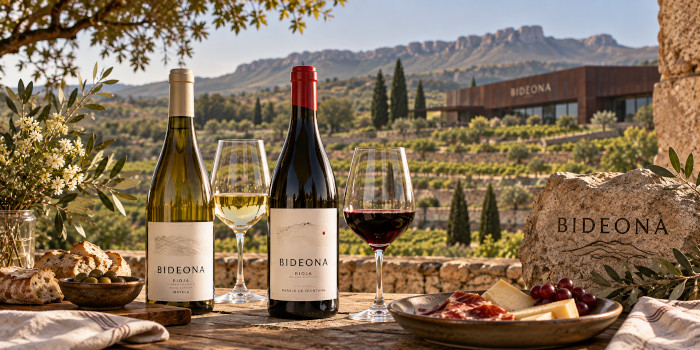
Bideona offers a particularly interesting way to explore Rioja. Instead of beginning with how long a wine has been aged, the producer starts with its vineyards, grapes and places, asking what makes each of them distinctive and how that character can be preserved in the finished wine.
The result is not an attempt to create one recognisable Bideona taste. The wines are deliberately allowed to be different, reflecting different grapes, vineyards and parts of Rioja Alavesa.
For us, that's the attraction. Bideona shows how diverse Rioja can be when the character of the grapes and their origins is allowed to shape the wine rather than being pushed towards a standardised idea of what Rioja should taste like.
Bideona was created with a very clear idea: to make wines that express their origin more strongly than their method of production.
That changes the starting point. Instead of asking first whether a wine should be Crianza, Reserva or Gran Reserva, Bideona looks at the quality and origin of the grapes and considers what the vineyard itself has to say.
The winery therefore works with regional wines, village wines and wines from more specific vineyards and sites. The purpose isn't to create another hierarchy for customers to learn. It's to recognise that different places within Rioja Alavesa can produce genuinely different wines.
Freshness, purity and precision are recurring ideas in Bideona's approach, but they don't amount to a single house style that every bottle is expected to reproduce.
The producer works with differences in grape, vineyard position, altitude, soil and village, then adapts its winemaking and maturation to the wine rather than using a predetermined ageing period to define what that wine should become.
That allows Tempranillo, for example, to show different expressions according to where it has been grown, while other grapes can retain identities of their own.
The result is a range that can be interesting to anyone curious about the diversity hidden behind the single word Rioja.
If you like the idea of Rioja where grape and origin are allowed to take centre stage, Bideona is certainly worth exploring.
You don't need to decide here which of its wines is right for you. Once Bideona's approach sounds interesting, your question has changed from “Why might I choose this producer?” to “Which Bideona wine should I choose?”
You can explore our Bideona wine collection to see the wines we currently stock and decide which expression is most relevant to what you're looking for.
If you're ready to look at the wines, you can do that now. If Bideona's approach has made you curious about why vineyards, villages and grapes can create such different expressions of Rioja, keep reading.
Bideona is rooted firmly in Rioja Alavesa, working with hundreds of small vineyard parcels spread across villages including Villabuena de Álava, Samaniego, Laguardia, Leza, Baños de Ebro, Navaridas, Lanciego and Elciego.
Many of these are old vineyards. Bideona's vines average around fifty years of age, with numerous parcels dating from the 1920s, 1930s and 1940s. The vineyards are generally small, and each parcel is managed individually according to its potential.
Altitude, limestone-rich soils, vineyard position and proximity to the Sierra Cantabria and River Ebro can all contribute to differences between sites. Bideona's philosophy is built around recognising those differences rather than blending them away simply to create consistency.
If that has made the region itself interesting to you, you can explore our Rioja Alavesa wines and see how other producers interpret the area.
Tempranillo dominates the vineyards of Rioja Alavesa, but Bideona's approach demonstrates that the name of the grape is only part of the story.
Tempranillo grown on different slopes and in different villages can produce different expressions, while Rioja Alavesa's old vineyards also preserve valuable diversity within the vines themselves. Viura and other white varieties provide another dimension again.
This is where Bideona particularly interests us. The wines don't feel as though the grape is merely an ingredient in a predetermined Rioja recipe. Its character is something the producer actively wants the finished wine to show.
If one of those grapes becomes your reason for exploring further, that is a separate decision. Our Rioja grape guides can help you understand the grape itself and whether its broader range of wines is likely to suit you.
One of the most interesting things about Bideona is the way its range demonstrates progressively more specific ideas of origin.
Some wines bring together vineyards from across Rioja Alavesa to express the broader character of the region. Others focus more closely on particular vineyard situations or individual villages.
Bideona's village wines take this idea particularly seriously. Grapes are selected from old vineyards within a particular municipality with the intention of showing something distinctive about that place.
This isn't something you need to memorise before buying a bottle. What it demonstrates is the producer's underlying proposition: Rioja Alavesa isn't one uniform place, and Bideona believes those differences are worth preserving in the glass.
Bideona doesn't reject Rioja's traditional ageing classifications. It simply asks a different question.
Crianza, Reserva and Gran Reserva describe an established way of understanding Rioja through maturation. Bideona instead classifies its principal wines according to the quality and geographical origin of their grapes, allowing the requirements of each wine and vintage to determine how it is matured.
Neither approach needs to make the other wrong. They are different ways of understanding what makes one Rioja meaningfully different from another.
If ageing classification is useful to you, our Crianza vs Reserva vs Gran Reserva guide explains what those classifications mean and how they can help you choose.
If Bideona's approach has made you curious about other ways of choosing Rioja, our Rioja Beyond the Ageing Ladder guide explores how place, grape, vineyard and producer philosophy can become more useful clues.
The wines we stock give us useful examples of Bideona's philosophy without requiring every bottle to perform the same job.
Laderas explores Tempranillo from hillside vineyards. Las Parcelas brings selected older vineyard parcels together to express Rioja Alavesa more broadly. V1BN4 takes the idea towards village identity, while Mayela provides another expression of the region through a fresh, unoaked interpretation inspired by Rioja Alavesa's traditional grower wines.
Those aren't recommendations about which bottle you should buy. They're evidence that Bideona's talk of grape, vineyard and origin leads to genuinely different wines rather than simply different labels.
Once those differences make you want to choose between the wines, the Bideona collection is the natural place to continue.
We stock Bideona because we like the way the wines focus on what is distinctive about their grapes rather than trying to create a standardised Rioja taste.
There is real diversity across the range, and that diversity feels purposeful. Different grapes, vineyards and origins are given the opportunity to show what makes them interesting rather than being made to conform to a single expectation of Rioja.
For us, that makes Bideona particularly useful alongside more familiar Rioja styles. It doesn't ask us to abandon those wines; it simply shows another side of the region and another way of understanding what Rioja can be.
If Bideona's approach now sounds interesting, view our Bideona wines. That's where the question moves from understanding the producer to deciding which expression best suits what you're looking for.
If you're still exploring Rioja more broadly, our Rioja Wine Guide – Which Rioja Is Right for You? will help you explore the region through colour, style, grape, place and producer.
If Bideona interests you but you're unsure which direction to take, get in touch with us. Tell us what you normally enjoy drinking or what you're hoping to find, and we'll be happy to help.
| Why Choose Izadi Wines? |
| Why Choose Bodegas Manzanos Wines? |
| White Rioja Style Guide – Which White Rioja Is Right for You? |