

0 items £0.00
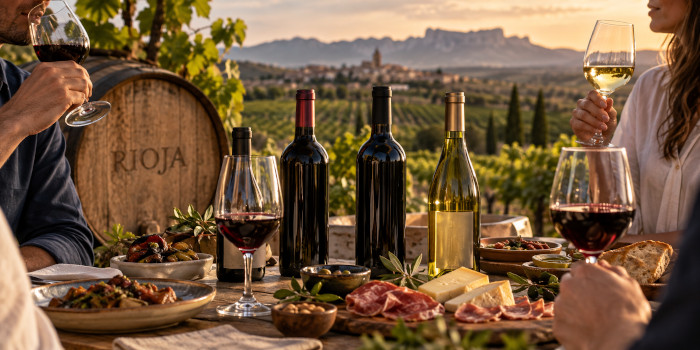
Crianza, Reserva and Gran Reserva provide one of the easiest ways to choose Rioja. They tell you something important about how a wine has been aged and can help you decide how youthful or mature you would like your Rioja to be.
But they don't tell you everything about the wine.
Where the grapes were grown can matter. So can the grape variety itself, the vineyard and the approach of the producer who made it.
So if ageing isn't the characteristic you want to choose your Rioja by, there are other useful ways to explore the region.
If you're deciding between youthful Rioja, Crianza, Reserva and Gran Reserva, the traditional ageing classifications are already giving you the information you need.
Compare Rioja Crianza, Reserva and Gran Reserva.
Rioja can increasingly be explored through origin – from its three major zones to individual villages and vineyards.
Keep reading and we'll explain how that works.
Tempranillo may dominate Rioja, but Garnacha, Graciano, Viura and other varieties can give you very different ways into the region.
If the grape is already what interests you, you don't need to choose an ageing classification first.
Different Rioja producers can have very different ideas about vineyards, grapes, blending, maturation and what they want their wines to express.
If you've already found a producer that interests you, exploring that producer may be more useful than starting with Crianza or Reserva.
This is the most important idea in this guide.
Crianza, Reserva and Gran Reserva tell you about ageing. Origin tells you where the wine comes from.
They aren't competing systems and one doesn't replace the other.
A wine can come from Rioja Alavesa and also be a Crianza. Another might identify a particular village or vineyard while also meeting an ageing classification.
Knowing one therefore doesn't necessarily tell you the other.
That means you can decide which piece of information matters most to the choice you're making.
For generations Rioja became internationally famous partly through wines blended from grapes grown across different parts of the region and matured according to the producer's preferred style.
That remains an important part of Rioja.
But origin can also be made increasingly specific, allowing producers to place greater emphasis on where the grapes themselves were grown.
That gives customers another way to explore Rioja: not simply “How long was this aged?” but “Where did this wine come from?”
Rioja is divided into three main geographical zones: Rioja Alta, Rioja Alavesa and Rioja Oriental.
Climate, altitude, soils, landscape and growing conditions vary across this large region. Those differences can influence the grapes grown there and the character producers are able to develop in their wines.
That doesn't mean every wine from one zone tastes alike, or that zone alone can predict exactly what will be in your glass.
It does mean origin can become a meaningful reason for exploring one group of Rioja rather than another.
If Rioja Alta itself is what interests you, that decision is already sufficiently clear. You don't need this guide to choose another characteristic first.
Likewise, if you've become interested in Rioja Alavesa – perhaps through a wine or producer you've already enjoyed – you can explore wines from that part of Rioja directly.
Explore our Rioja Alavesa wines.
If Rioja Oriental is the part of the region you want to investigate, that geographical choice can be your starting point.
Explore our Rioja Oriental wines.
Yes.
Rioja's origin classifications can become more precise than Rioja Alta, Rioja Alavesa or Rioja Oriental.
Wines can identify a particular municipality or village when the appropriate requirements are met. That allows the producer to place greater emphasis on a more specific place within Rioja.
The classification can become narrower again with Viñedo Singular, which identifies wine from a specifically delimited vineyard meeting additional requirements.
So geographical origin can move from:
Rioja → Zone → Village or Municipality → Individual Vineyard.
But that doesn't mean you have to work your way down that sequence before buying a bottle.
If an individual vineyard is what attracted you to a wine, the vineyard is already your reason for exploring it. If you're simply interested in Rioja Alavesa, there is no need to manufacture a more specific question.
No.
A wine from an individual vineyard isn't automatically better than a Rioja made from grapes drawn from several sites, just as a Gran Reserva isn't automatically better than a Crianza.
Greater geographical specificity tells you something different: the producer has chosen to identify the wine more closely with a particular place.
That may be fascinating if origin is what interests you.
But a producer can deliberately blend grapes from different vineyards or places because that combination creates the wine they want to make.
Again, these are different approaches rather than steps on another quality ladder.
Origin isn't the only alternative to choosing by ageing.
You may already know that a particular grape is what interests you.
Perhaps you want to explore the different expressions of Tempranillo. Perhaps you enjoy the fruit and generosity of Garnacha. Perhaps Graciano has caught your attention, or you're exploring White Rioja through Viura.
At that point, the grape has become your choosing question.
You don't need this guide to resolve it for you.
Explore our Tempranillo Wine Guide.
Explore our Garnacha & Grenache Wine Guide.
Explore our Graciano Wine Guide.
Explore our Viura & Macabeo Wine Guide.
Another customer might approach exactly the same region differently.
You may discover a producer whose wines particularly interest you and want to understand what connects them.
One producer might place particular emphasis on vineyards and origin. Another might be interesting because of the grapes it explores, the way it works in the vineyard or cellar, or the range of Rioja styles it produces.
Producer therefore isn't simply another name on the label. Sometimes understanding the producer helps explain why a group of wines exists and why they differ.
Once a particular producer has become your reason for choosing, its producer guide and collection are better places to continue than a general guide to Rioja.
Winemaking can make an enormous difference to Rioja.
Fermentation, blending, barrels, lees, extraction, maturation and many other decisions can influence the finished wine.
But not every technical difference needs to become a separate way of shopping.
Where a winemaking choice creates a useful customer decision, it can make sense to follow it. Barrel-fermented White Rioja is a good example because customers may actively want that richer, more textured style.
Elsewhere, winemaking may simply help explain why two wines from the same grape or place taste different.
The important question isn't whether a technical difference exists. It's whether that difference helps you make a useful choice.
Some are simply youthful wines made to emphasise fresh fruit rather than extended maturation.
Others may have been aged, but don't conform to the requirements for Crianza, Reserva or Gran Reserva – and their ageing category may not be the most useful reason for choosing them.
That is why a Rioja without one of the familiar ageing terms shouldn't automatically be interpreted as a simple young wine.
Its grape, vineyard, origin or producer's intention may tell you considerably more about why the wine is interesting.
If what you actually want is a fresh, youthful Rioja, you can explore our Rioja Joven collection.
No.
A Rioja can be interesting because of where it comes from and how it has been matured.
You might discover a Reserva from Rioja Alavesa and care about both facts. Another customer might choose the same wine primarily because they already enjoy the producer.
Neither customer is choosing it incorrectly.
These are simply different pieces of information helping different people make the same purchase.
That's why it is more useful to think of ageing, origin, grape and producer as different ways into Rioja rather than competing classification systems that force every wine into a single route.
Start with the question you are actually trying to answer.
Use the ageing classifications.
Compare Crianza, Reserva and Gran Reserva.
Let origin lead your choice.
Explore Rioja Alta.
Explore Rioja Alavesa.
Explore Rioja Oriental.
Follow the grape rather than forcing your choice through the ageing ladder.
Our grape guides will help you understand what each variety can offer before you choose a wine.
Explore what makes that producer interesting and then choose between the wines it makes.
Then you haven't failed to choose. You simply have a broader Rioja decision still to resolve.
Read Rioja Wine Guide – Which Rioja Is Right for You?
The familiar ageing ladder remains one of Rioja's great strengths. Crianza, Reserva and Gran Reserva provide a genuinely useful way of understanding how maturation can change a wine.
But it is one way into Rioja, not the architecture of Rioja itself.
Origin can take you from one of the region's three zones towards increasingly specific places and vineyards. Grapes can reveal another side of the region. Producers can give those grapes and places their own interpretation.
You don't have to resolve all of those dimensions before choosing a bottle.
You only need to identify which one matters to you now – and follow it far enough to make your next sensible choice.
If you'd rather see everything together, browse our complete Rioja wine collection.
If you're still unsure, get in touch or visit us in the shop.
You don't need to arrive knowing whether you're looking for a zone, grape, vineyard, producer or ageing classification. Tell us what has interested you about Rioja so far and what sort of wine you're hoping to find, and we'll help you work out which direction makes sense.
| Why Choose Izadi Wines? |
| Why Choose Bodegas Manzanos Wines? |
| White Rioja Style Guide – Which White Rioja Is Right for You? |